

As organizations grow digitally, APIs become a very important part of their applications. They help systems talk to each other, connect partners, and enable new digital experiences at speed.
In most OutSystems programs, APIs start small. But as more applications, teams, and integrations are added, the number of APIs grows very quickly. Over time, this creates a complex web of dependencies across systems.
OutSystems makes application development fast and easy. However, when APIs grow without clear standards and control, hidden problems start to appear, such as security gaps, duplicate APIs, inconsistent contracts, and manual compliance work.
Small API changes begin to impact multiple applications. Release risks increase. Teams slow down, even though the platform itself is designed for speed.
This is where API Governance becomes important.
Not to slow teams down, but to create a stable foundation where APIs can scale safely, securely, and in a predictable way.
Why API Governance Is Needed Now
As OutSystems platforms mature, APIs multiply across internal systems, external partners, and digital products.
Without governance, teams often face:
- Duplicate APIs solving the same problem
- Inconsistent contracts and naming standards
- Point-to-point integrations that are hard to change
- Manual security and compliance checks
- Unclear ownership when issues arise
Over time, this increases delivery risk and slows innovation, exactly the opposite of what low-code promises.
API governance is not about control. It is about clarity, consistency, and predictability.
A Simple Governance Model for OutSystems
The framework explained in the detailed guide is based on a federated model.
This means:
- Central rules and standards
- Freedom for teams to build and innovate
It focuses on three simple building blocks:
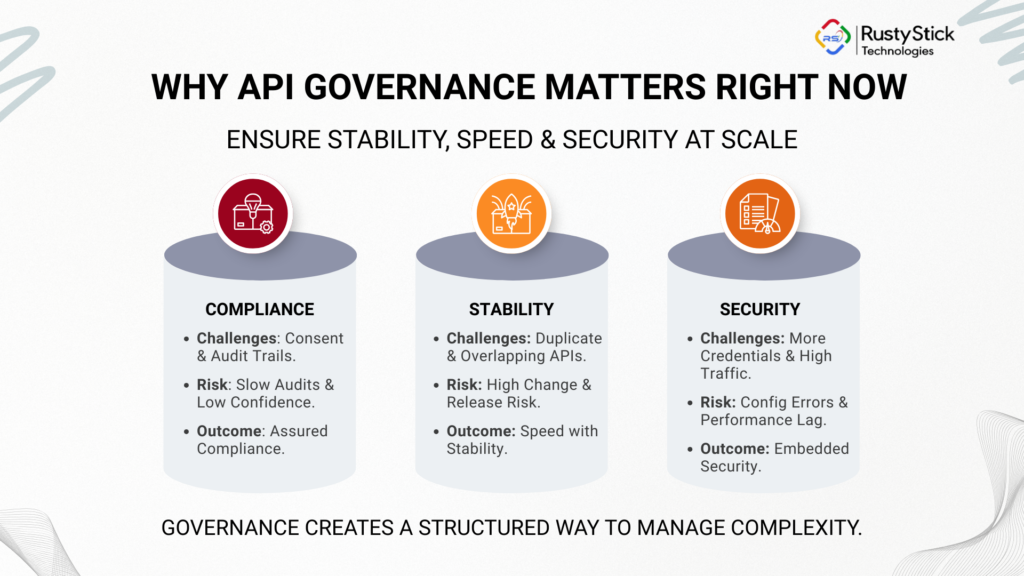
1. Secure Access with a Trust Gateway
All APIs are protected in one central place.
This includes authentication, access control, rate limiting, and threat protection.
👉 Result: Security becomes consistent and scalable.
2. Standard APIs with a Central Catalog
All APIs are documented and stored in one place.
Teams can easily find, reuse, and understand existing APIs.
👉 Result: Less confusion, faster development.
3. Easy Compliance with Consent Management
Customer consent is captured, validated, and logged automatically across APIs.
👉 Result: Always audit-ready, with less manual effort.
What Organizations Gain
With proper API governance in OutSystems:
- Faster onboarding of new consumers
- Safer scaling as usage grows
- Fewer integration issues
- Better platform stability
- Faster and more reliable releases
How to Get Started
Instead of changing everything at once, governance can be introduced step by step, starting with discovery, then security, standardization, and finally scaling.
Want to Go Deeper?
This blog gives you a quick overview.
If you want step-by-step details, architecture insights, and an implementation roadmap, you can download the complete guide.
👉 Download the full API Governance Guide to understand how to implement this framework in real OutSystems programs.