
Claims processing is rarely the most visible part of a healthcare organization, yet it is one of the most operationally sensitive.
Behind the scenes, claims teams manage thousands of submissions, evolving payer rules, strict documentation requirements, and constant follow-ups. Small gaps in accuracy or timing can quietly turn into denials, delayed reimbursements, or revenue leakage that only surfaces weeks later.
As healthcare organizations scale, these challenges become harder to control. Manual processes struggle to keep pace with growing volumes, policy updates vary across facilities, and delivery teams are forced into continuous firefighting rather than planned optimization. The result is operational strain, unpredictable cash flow, and limited room to improve patient experience.
This is why many healthcare leaders are now re-examining claims processing, not as a back-office function, but as a strategic capability that demands standardization, governance, and intelligent automation.
AI-assisted claims processing has emerged as a practical way to address these pressures. When applied with the right controls, it helps organizations improve consistency, reduce avoidable rework, and build a foundation for scalable, future-ready operations.
Why Claims Processing Needs a Rethink Now
Across healthcare systems globally, claims teams face the same set of challenges:
- Rising claim denial rates due to stricter payer scrutiny
- Slow and inconsistent prior-authorization processes
- Heavy manual workload on revenue-cycle teams
- Limited price transparency for patients
- Complex and frequently changing payer contracts
Together, these issues increase operational risk, reduce predictability, and limit the ability to scale efficiently.
AI, when applied with governance and oversight, helps organizations address these challenges by standardizing decisions and reducing avoidable variation.
What Is AI-Assisted Claims Processing?
AI-assisted claims processing is not a standalone tool.
It is a central capability layer that supports hospitals, departments, and payer relationships consistently.
In practice, this capability can:
- Validate claims before submission to prevent avoidable denials
- Prepare prior-authorization packages using clinical notes and payer rules
- Automate repetitive administrative tasks
- Generate real-time cost estimates for patients
- Detect underpayments and contract variances early
The result is higher consistency, faster cycles, and stronger governance across the revenue cycle.
Strategic Outcomes That Matter to Healthcare Leaders
When implemented thoughtfully, AI-assisted claims processing delivers outcomes that directly impact operational and financial performance:
1. Enterprise-Wide Governance and Standardization
- Consistent payer rule interpretation across facilities
- Full audit traceability of automated decisions
- Reduced variation in documentation quality
2. More Predictable Revenue Cycles
- Higher clean-claim rates
- Fewer payer clarifications
- Faster reimbursement timelines
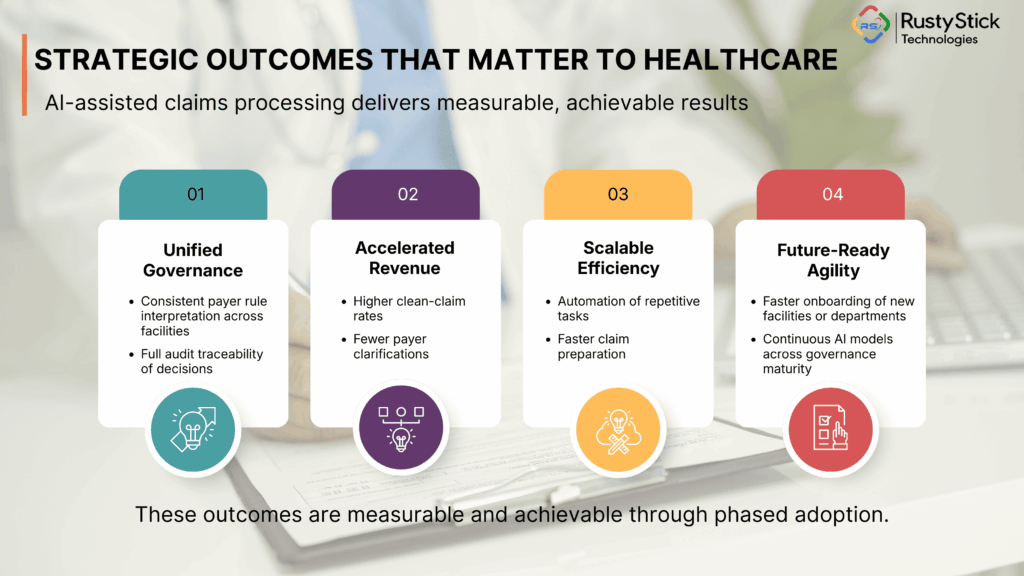
3. Workforce Scalability Without Headcount Growth
- Automation of repetitive tasks
- Faster claim preparation
- Higher throughput per resource
4. Future-Ready Operations
- Faster onboarding of new facilities or departments
- Reuse of AI models across adjacent workflows
- Continuous improvement in governance maturity
These outcomes are measurable and achievable through phased adoption.
A Practical, Low-Risk Way to Get Started
Leading healthcare organizations approach AI adoption incrementally:
- Align on business outcomes and governance boundaries
- Prepare rules, workflows, and compliance guardrails
- Validate using historical claims data
- Run a controlled pilot before scaling
This ensures operational stability while building confidence across stakeholders.
Want the Full Strategic Framework?
This blog provides a high-level view.
For a detailed, end-to-end guide covering:
- Governance models for AI-assisted decisions
- Measurable operational and financial KPIs
- A structured, four-phase adoption roadmap
- Benchmarks for scalability and compliance