OutSystems applications may not always be visible, but they support some of the most critical business operations.
OutSystems 11 platforms are stable, trusted, and deeply embedded in daily workflows. At the same time, growing demands for AI, modern user experiences, and scalable digital services are pushing organizations to evolve faster.
Treating this shift as a full migration often creates unnecessary risk. Rushed changes can disrupt stability, slow delivery, and increase complexity.
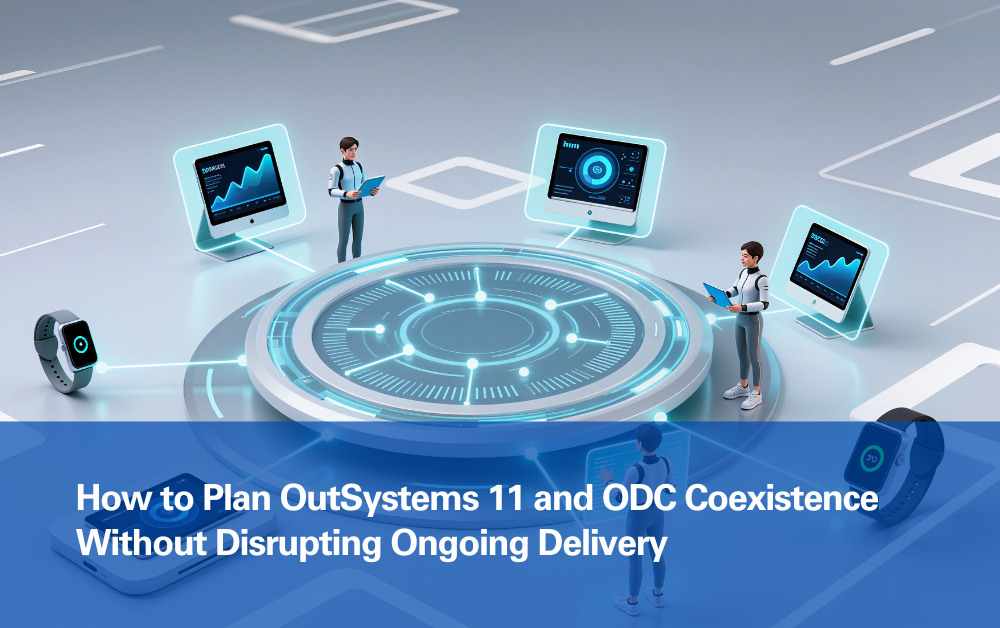
This is why many organizations are now looking at OutSystems 11 and ODC coexistence, a way to protect what already works while enabling innovation where it matters.
A planned coexistence strategy allows modernization to move forward without disrupting ongoing operations.

Why OS11 + ODC Together Makes Sense
OutSystems 11 continues to be a strong platform for core, stable applications. But newer needs like AI-driven automation, unpredictable traffic, and modern UX are natively supported in ODC.
Instead of a risky full migration, a coexistence model allows teams to:
- Keep mission-critical systems running on OS11
- Build new innovations and external apps on ODC
- Avoid delivery delays and re-platforming risks
This approach reduces innovation debt while protecting delivery timelines.
How Unified Fabric Reduces Complexity
A common fear is that running two platforms will double complexity. In reality, OutSystems’ Unified Development Fabric avoids this.
With shared Data Fabric and Identity, teams get:
- One source of truth for data
- Single sign-on across OS11 and ODC
- Central governance and security control
From a project manager’s view, this means fewer dependencies, cleaner ownership, and predictable execution.
What to Build Where
A simple rule helps decision-making:
| Application Type | Recommendation | Rationale |
|---|---|---|
| Core Transaction Systems (e.g., Financial Reconciliation) | Stay on OS11 | High stability required; low need for UX innovation. Migrating offers low ROI. |
| External Portals (e.g., Interfood Connect, Supplier Onboarding) | Build in ODC | Requires auto-scaling, modern React UX, and mobile-first design for 1,443 customers. |
| AI & Automation (e.g., Logistics Prediction, Market Analysis) | Build in ODC | Requires ODC-exclusive “Agent Workbench” and high-compute power. |
| Small Internal Tools (e.g., HR Leave Requests) | Stay on OS11 | “Keep the lights on” mode. Only migrate if part of a larger refactor. |
💡The Rule: Do not migrate stable legacy apps just for the sake of it. Build innovations only on ODC.
A Safer Way to Move Forward
Coexistence is not a tooling exercise; it’s a delivery strategy. A phased roadmap helps teams modernize step by step without impacting SLAs, users, or ongoing releases.
Want the Full Architecture, Decision Matrix & 6-Month Roadmap?
This blog only scratches the surface.
- Architecture patterns for OS11 + ODC coexistence
- Governance and licensing considerations
- A practical execution roadmap designed for PMs and Delivery Heads
Modernize at your pace, without disrupting what already works.