

As OutSystems adoption grows, teams move fast.
More apps, more changes, more delivery pressure.
To manage this scale, many organizations shift to a pod-based delivery model, with small teams responsible for specific applications or business areas.
But here’s the reality 👇
Making pods is easy, but making high-quality pods is difficult.
Without the right structure, pods often create:
- Inconsistent code quality
- Architecture deviations
- Hidden dependencies
- Rework and delivery delays
- Growing technical debt
This blog explains how to build high-quality OutSystems pods simply and practically.
Why Pod Quality Matters More Than Pod Count
As OutSystems adoption grows, teams naturally scale by adding more pods.
That approach makes sense.
But when pods are formed without clarity, teams start facing:
- Inconsistent code quality
- Architecture deviations
- Hidden dependencies between pods
- Rework and release delays
- Growing technical debt
More pods without quality controls don’t increase speed; they increase risk.
High-quality pods focus on predictable delivery, not just fast delivery.
What Makes a High-Quality OutSystems Pod
A common misconception is that a pod is just a group of developers.
In reality, a high-quality OutSystems pod is a balanced delivery unit where:
- Architecture decisions are owned
- Requirements are clear before development starts
- Code quality is reviewed continuously
- UI and UX remain consistent
- Testing happens early, not at the end
When these basics are missing, delivery may look fast today, but it becomes unstable tomorrow.
Clear Roles Are the Foundation of Strong Pods
One simple rule explains most pod failures:
When responsibility is unclear, accountability breaks.
High-quality pods work because each role has a clear purpose:
- Architecture stays aligned with long-term goals
- Business requirements are converted into a buildable scope
- Technical decisions are reviewed early
- Senior developers guide quality, not just code
- QA validates continuously
- UI consistency is maintained across applications
This clarity prevents last-minute surprises and repeated fixes.
How High-Quality Pods Stay in Sync
Strong pods don’t rely on heroics.
They rely on coordination.
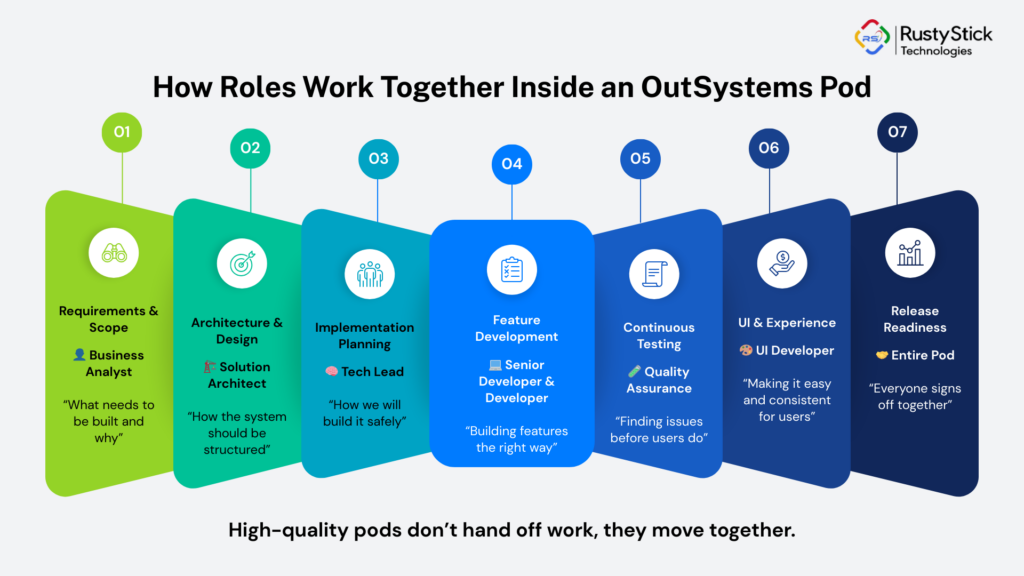
A typical high-quality pod flow looks like this:
- Requirements are clarified and validated early
- Architecture and module boundaries are defined upfront
- Implementation is planned with reuse and performance in mind
- Development happens with continuous feedback
- QA validates features throughout the lifecycle
- UI consistency is checked alongside development
- Final release happens with confidence, not assumptions
This shared rhythm is what keeps delivery predictable.
A Safer Way to Scale OutSystems Delivery
Building pods is easy.
Building high-quality pods is a delivery strategy.
Instead of rushing to scale headcount, teams should focus on:
- Clear pod structure
- Defined ownership
- Strong coordination between roles
When the structure is right, speed follows naturally, without increasing technical debt or delivery risk.
Want the Full Pod Structure, Role Clarity & Execution Framework?
This blog only scratches the surface.
- A complete, high-quality OutSystems pod structure
- Clear role responsibilities and hand-offs
- Common pod design mistakes to avoid
- A practical framework to scale delivery without losing quality
Build pods that deliver faster, without breaking what already works.
👉 Download the detailed guide to explore: